

Why Your Scalp Feels Tight - And What That Has to Do With Your Face
Press your palm flat against your scalp and try to move the skin. Does it slide easily, or does it feel stuck to the bone underneath? If it barely moves, that tightness isn’t just a scalp issue — it’s connected to how your whole face holds tension.
In Traditional Chinese Medicine, the head is described as “the meeting place of all yang meridians” — nearly every major energy pathway in the body passes through or terminates at the scalp. The Governing Vessel runs straight down the center. The Gallbladder and Bladder meridians wrap around the sides and back. When these pathways get congested — from stress, poor sleep, or just never touching your scalp — the tension doesn’t stay contained. It pulls forward, through the galea aponeurotica (the flat tendon-like sheet connecting your scalp muscles to your forehead and face), and shows up as a heavier brow, flatter cheeks, or a face that just looks tired even when you’re not.
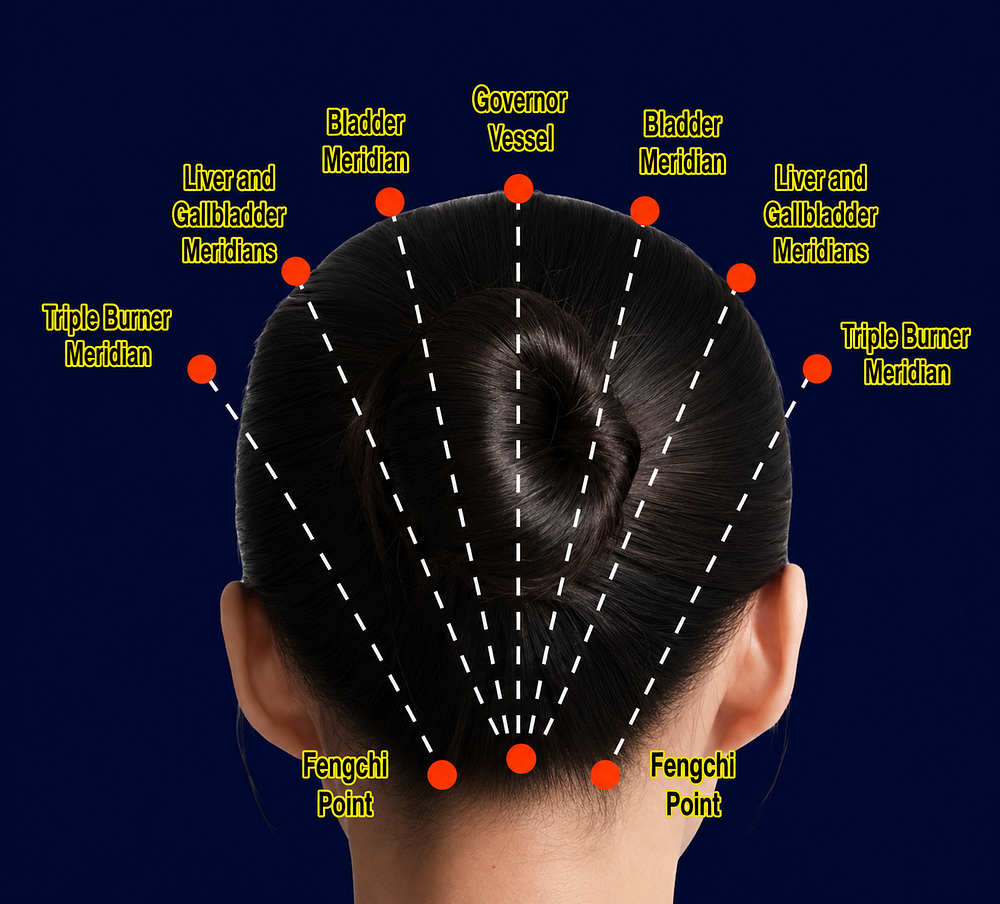
This is why facial massage alone often plateaus. You’re working the surface, but the tension is anchored higher up.
How to deal with it:
1. Find it: Trace an imaginary line from the top of one ear to the top of the other. Where that line crosses the center of your head — the highest point of your scalp — that’s Baihui (the crown point on the Goveror Vessel).
2. What it does: Gentle, consistent pressure here is traditionally understood to support qi and blood circulation to the head, easing the kind of tightness that radiates into the forehead and temples.
3. How much time: 2–3 minutes daily, using a wooden guasha comb or your fingertips in slow, deliberate strokes from the hairline back toward the crown. Consistency matters more than pressure — this isn’t something you force.
No comb, no time? Just spend 30 seconds raking your fingers through your scalp before bed, working from front to back. Even that small habit, done daily, adds up.